Cornering: A-Frame Turn
How do you ride your first turn on skates? With the A-frame turn — a wide, parallel stance, head and shoulders leading, pressure on the outer skate's inside edge.
Introduction
How do you ride your first safe turn without it throwing you off track? Here's the honest answer: with a wide, parallel stance, head and shoulders leading, and pressure on the inside edge of your outer skate. That's the A-frame turn — the final technique in the beginner curriculum and your ticket out of stubborn straight-line skating.
Remember the wedge turn from skiing? The A-frame turn is exactly that principle on wheels. It's the easiest way to change direction because you ride it from a very wide stance — you never have to lift the skates off the ground or switch to risky outside edges. The arcs come from shoulder rotation and edge pressure.
What You Need
- Full protective gear: a helmet, wrist, elbow, and knee guards — the shift in your center of mass can cause minor balance loss at first.
- Firmly laced skates: with skates laced too loosely, your ankles buckle uncontrolled inward during the weight shift.
- A wide, flat area: an empty parking lot or schoolyard with no slope, so you can focus purely on your turning radius.
- Prerequisite: you can glide straight ahead confidently (level 5) and you can brake (level 8).
Step by Step
1. The Starting Position (Wide Stance)
Skate straight ahead at a moderate, comfortable speed. Drop into a deep ready stance — knees bent deeply, upper body leaning slightly forward — and open your legs noticeably wider than shoulder-width. Both skates stay parallel — your legs form the A, not the skates. Otherwise you'll mix it up with the plow from level 9 and brake instead of turning. In this position, you have plenty of lateral stability.
2. Gaze Direction and Shoulder Rotation
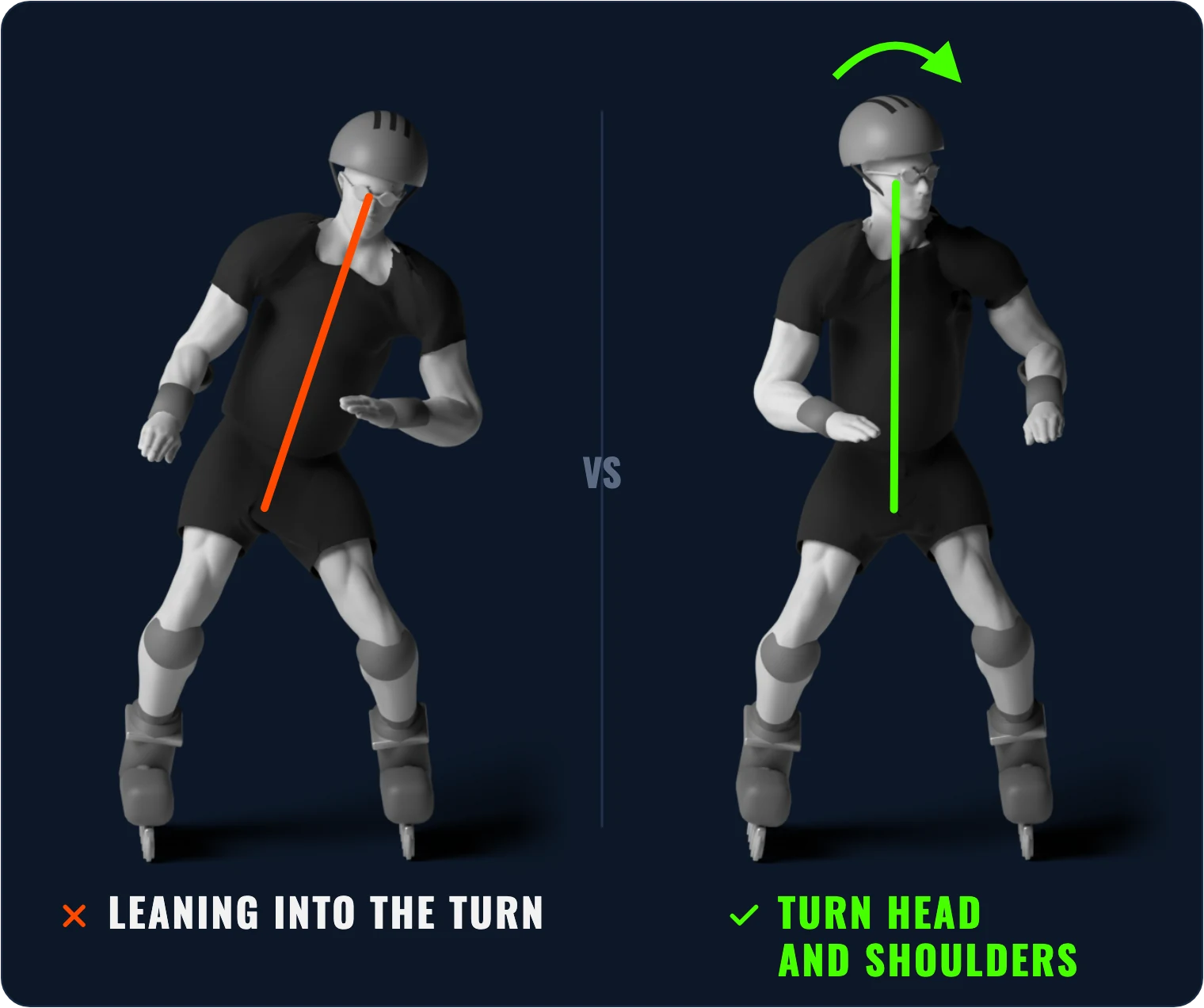
Your body always follows your head. Want to turn left? Turn your head and gaze to the left, toward the new direction, first. Let your shoulder and upper body gently follow that gaze. This pre-rotation unlocks your hip and gives the skates the impulse to steer.
3. Pressure on Your Outer Skate
The real cornering secret: turning your head and shoulders puts more weight on your outer skate — the right one in a left turn. Press it onto its inside edge, onto the ball of your big toe. That starts a smooth, controlled arc, and your inner leg just follows along loosely. Don't lean sideways — that pushes your weight onto the wrong leg.
4. Riding Out the Turn
Hold the pressure on your outer skate while you carve the arc, and stay deep in your knees to absorb the centrifugal force. Once you've reached your desired new direction, shift your weight back evenly (50/50), release the edge pressure, and glide straight ahead in parallel again.
Common Mistakes
- Weight on the inside leg of the turn. The classic mistake: lean inward out of fear and you lose edge grip on the steering outer leg. The skates just keep rolling straight, or you tip roughly toward the inside of the turn.
- Stiff knee joints. With locked-out legs, you physically can't transfer the needed pressure onto the inside edge of your outer skate. The force fizzles out — you have to go deep into your knees.
- Rigid shoulders. Stare tensely straight down while trying to steer with your feet and you block your own biomechanics. The rotation has to start up top, with your head.
Safety Notes
When practicing, make sure your surface is free of gravel or loose stones — skates react more sensitively to sliding while leaned into a turn. If you lose your balance during the A-frame turn, remember the most important rule in inline skating: "Oh no, go low!" Bend your knees even deeper right away to lower your center of mass. And at first, practice at moderate speed with wide arcs.
Pro Tip
Use a mental cue from sports psychology: while shifting weight onto your outer leg, intensely think the word "carve." This visualization helps your brain understand the movement not as passive rolling, but as actively pressing your outer skate's inside edge into the asphalt — that makes your turning radii more precise.
FAQ
Why does my outer leg just slide out during the turn?
It's usually a lack of edge pressure, either because your knees are too stiff or there's too little pressure on your outer skate's inside edge. Consciously drop deeper into your knees and check whether you're actually shifting weight, not just thinking about shifting it.
How wide does my A-frame stance really need to be?
Noticeably wider than shoulder-width, both skates parallel — but there's no exact number — the right width feels stable without contorting you. As a rule of thumb: wider than normal walking, but narrow enough that you can comfortably bend your knees.
Can I ride the A-frame turn at higher speed too?
Yes, but as a beginner it's better to practice it at moderate speed first. With more experience, it works at higher speed too — until then: moderate speed, wide arcs.
What if I keep turning too tight or too wide?
Your radius depends on how far you turn your head and shoulders and how much pressure you put on your outer skate's inside edge. For tighter turns, rotate more and press harder; for wide arcs, gentler pressure is enough.
Do I need special skates for the A-frame turn?
No, any well-fitting fitness or recreational skate works. What matters is that the lacing is firm — with loosely laced skates, your ankle buckles uncontrolled during the weight shift before the edge even grips.
Key Takeaways
- The A-frame turn is the inline equivalent of the wedge turn in skiing and the primary method for direction change for beginners.
- The turn comes from the wide stance, the rotation of your head and shoulders, and pressure on the inside edge of your outer skate.
- Head and shoulders initiate the movement — your gaze must always lead toward the desired new direction first.
Next guide
Advanced Braking Techniques: T-Stop and Spin Stop