Basic Posture and Getting Up
The ready stance is your foundation for everything: knees bent, weight on the balls of your feet, eyes forward. Plus: how to get up without rolling away.
Introduction
"How do I actually stand up safely on skates without instantly rolling away?" Honest answer: with the right basic stance — the ready stance — and a clear sequence for getting up. That's the foundation everything else builds on. Skip it, and you'll still be fighting wobbly legs weeks later.
Skating isn't walking with wheels bolted on. Instead of rolling heel-to-toe, you push off sideways, and your body needs a completely different kind of balance for that. The ready stance gives you exactly the stable platform you need — for accelerating and for absorbing bumps alike. In this guide, we'll build that foundation together.
What You'll Need
- Full protective gear: helmet, wrist guards, elbow pads, and especially thick knee pads — non-negotiable.
- A soft surface to start on: grass or an old carpet. Grass slows the wheels down a lot, so you don't roll away the second you stand up.
- Snugly laced skates with a tight cuff that actually supports your ankle.
Step by Step
1. Get Up Off the Ground Safely
After putting your skates on, you're usually sitting in the grass. Roll onto your stomach and get onto all fours — your weight resting on your wrist guards and knee pads.
2. Plant One Foot
Bring your stronger foot forward and set the skate down completely flat on all four wheels. Your upper body naturally starts to straighten as you do.
3. Push Up
Put both hands on the knee of the planted leg, shift your weight onto it, and push yourself up using the strength in your thighs and arms.
4. Get Into the V-Position
Immediately bring the second skate in and place it so your heels almost touch and your toes point outward — like a V. In this position you won't roll backward. But careful: shift your weight forward and you'll start rolling — that's exactly how the V-Walk starts later.
5. Take the Ready Stance
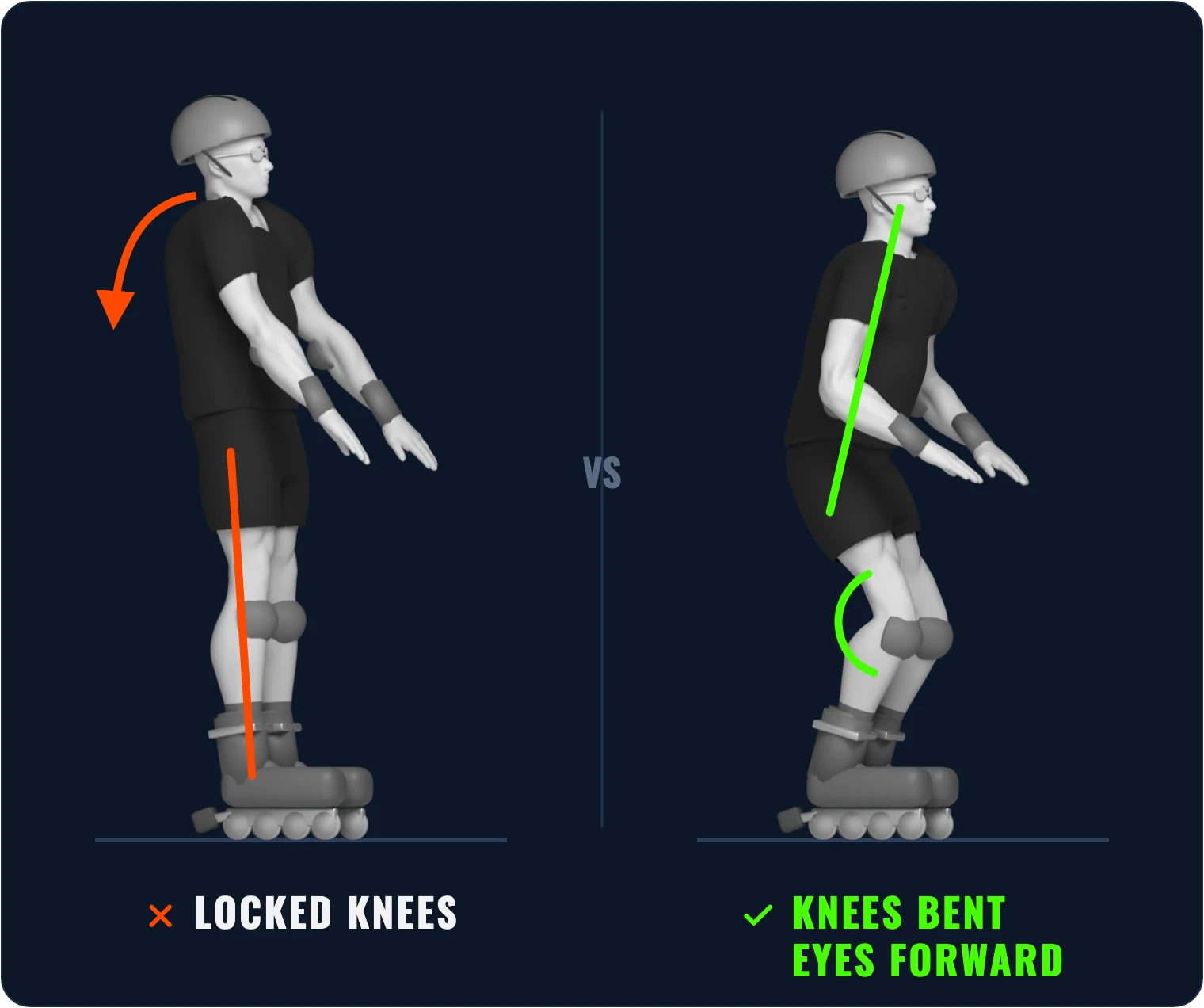
Now for the real basic stance: bend your knees noticeably, until they sit directly above your toes — you should feel the cuff pressing against your shin. Keep your back straight but lean slightly forward from the hips. Head up, eyes forward into the distance, not down at your feet. Weight on the balls of your feet, skates no wider than shoulder-width. This turns your thighs and glutes into built-in shock absorbers that soak up bumps for you.
Common Mistakes
Locked knees are a classic beginner mistake: your weight shifts onto your heels, and even a small disturbance can tip you backward. Looking down rounds your back and tips your center of gravity forward — you end up looking like a question mark on wheels and lose your balance. Standing too wide robs you of the ability to press cleanly onto the inside or outside edge of your wheels (called edging) — the stance becomes unstable and burns energy for nothing.
Safety Notes
A helmet and pads are mandatory here, not optional — losing control is simply part of learning balance. Remember our rule of thumb: "Oh no, go low!" If you feel yourself losing balance, bend your knees even deeper, right away. That lowers your center of gravity and often brings you back into balance — and if it doesn't, it at least turns a hard backward fall into a controlled forward one onto your pads.
Pro Tip
Use grass as your shortcut. Since blades of grass slow the wheels down, a lawn is the perfect place to get a feel for your new gear. Practice getting up, the ready stance, and shifting your weight from leg to leg there for a few minutes, until the deep knee bend becomes automatic (your body stores this as proprioception — its own sense of position in space). Only move to smooth asphalt once it feels solid.
FAQ
How deep do I actually need to bend my knees when skating?
Deep enough that they sit directly above your toes and you feel the cuff pressing into your shin. It feels exaggerated at first, but it's the only position you can absorb shocks and control your weight from. Locked knees are a typical reason for backward falls.
Why do I keep rolling away the moment I stand up?
You're probably not landing in the V-position. Heels together, toes pointing out — your heels bump into each other, so you won't roll backward. Keep your weight centered over the skates while getting up: if it tips forward, you'll start rolling even in the V.
Do I really need to practice on grass, or can I just go straight to asphalt?
Grass isn't mandatory, but it's a huge advantage: grass slows the wheels down a lot, so you're not constantly fighting rolling away while you practice getting up and the ready stance. On asphalt you'll learn the same movements more slowly and with more fall risk.
What do I do if I suddenly lose my balance while skating?
Bend your knees even deeper instead of straightening up. That's the "oh no, go low" principle: a lower center of gravity often brings you right back into balance on its own — and if it doesn't, you'll land flat and controlled on your knee pads instead of hard on the back of your head.
How wide should my feet be in the ready stance?
No wider than shoulder-width. A wider stance might feel more secure, but it stops you from cleanly pressing onto the inside or outside edges of your wheels — and that edging is exactly what you'll need for every turn and stop later on.
Key Takeaways
- The ready stance — knees bent, weight on the balls of your feet, eyes forward — is the starting position for everything on skates.
- Locked knees shift your weight onto your heels — a typical reason for falling backward.
- In the V-position (heels together, toes out) you won't roll backward — shift your weight forward and you start rolling.
Next guide
Learning to Fall Under Control