Learning to Fall Under Control
Afraid of falling? Learn the three rules on grass: get low, land on your knees first, keep your hands off the ground — that's how you protect your wrists.
Introduction
"Why am I terrified of falling even though I'm wearing pads?" Honest answer: because you've never felt what a fall onto your pads is actually like. That's exactly what you practice here — on grass, from a standstill, with three clear rules: get low, land on your knees first, keep your hands off the ground.
Why the hands? The most common inline skating injury is a broken wrist — roughly one in four injuries, usually after falling onto an outstretched hand. So the reflex to catch yourself is exactly the one you're training out. No two falls are the same — that's why you don't learn a rigid choreography, but rules that work in any situation.
Practicing controlled falls takes a lot of the fear away for many people, because you experience that a fall onto your pads usually ends harmlessly. It's not a free pass — but it gives you a much calmer baseline for every level that follows.
What You'll Need
- Full protective gear: helmet, wrist guards, elbow pads, and above all knee pads — no compromises here.
- A soft grass surface: grass slows the wheels down a lot and cushions the impact at the same time.
- Your inline skates, laced properly for a firm heel hold.
Step by Step
1. Get Set Up on the Grass
Walk onto a flat lawn with your skates on and take the ready stance: feet roughly hip-width apart and parallel, knees bent, weight on the balls of your feet, eyes forward. Feel how stable this posture is.
2. Practice "Oh No, Go Low!"
Now simulate losing control. Instead of straightening up, drop low into your knees right away — as if sitting down on a low stool. This lowers your center of gravity and shortens the distance to the ground. The shorter the distance, the softer the landing.
3. Fall Onto Your Knees
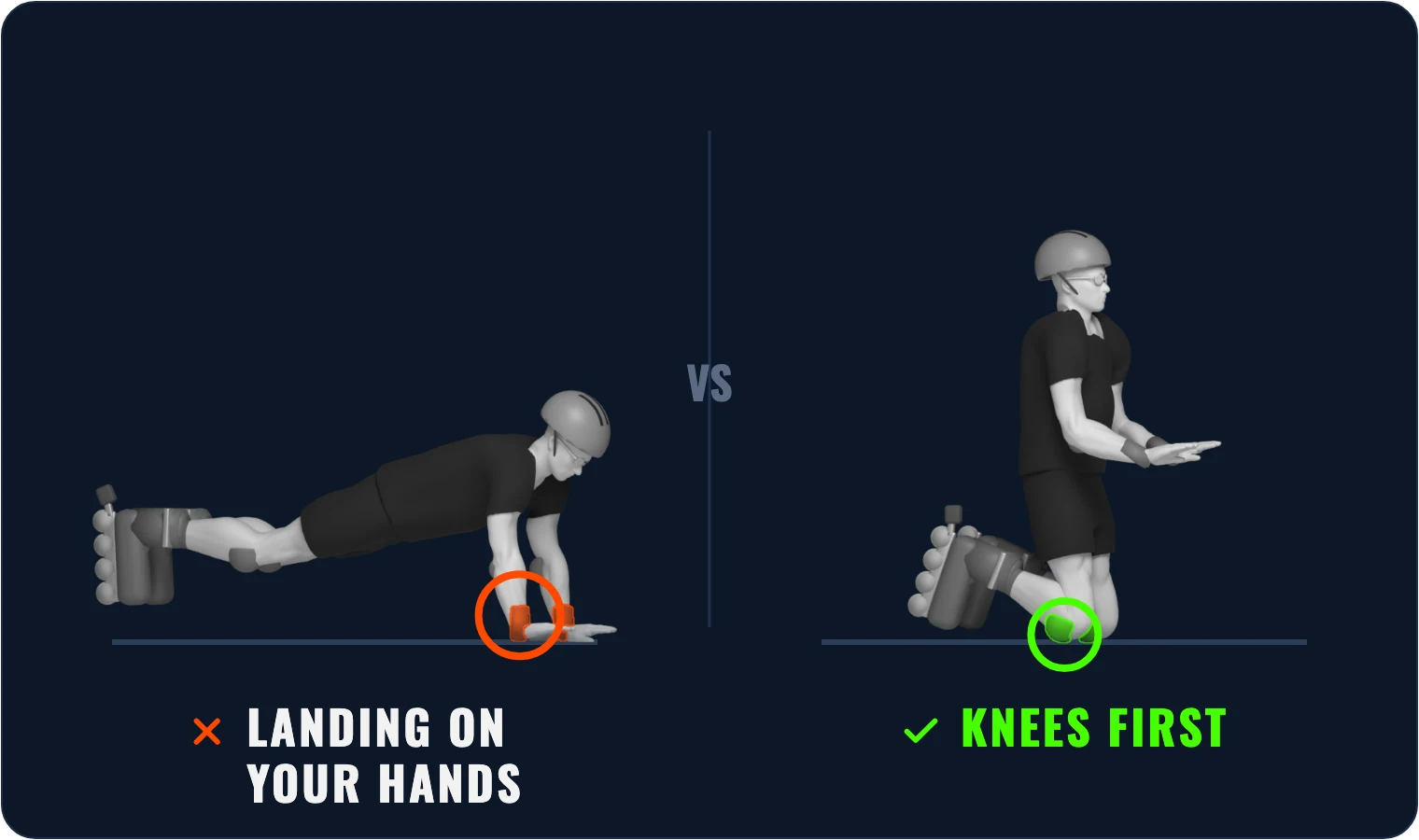
From the low crouch, let yourself fall forward onto both knee pads. Upper body upright, head up, hands not on the ground. If your upper body keeps tipping forward, your forearms and wrist guards go down with it — fingers pointing up.
Your arms don't catch anything. They're only there in case you keep tipping.
4. Repeat Until It's Routine
Practice the sequence several times on the grass until getting low and dropping to your knees happens without thinking. Ten to fifteen deliberate reps per session are a good start.
5. Later: From Slow Rolling
Once it works on grass, practice the same fall from slow rolling on smooth asphalt: get low, put one padded knee down, then the second if needed. Now your pads may briefly slide across the ground — that's what they're made for. Until you can brake properly, this is your emergency exit.
Common Mistakes
- Straightening up when you lose control (windmill arms): lock your legs and flail your arms, and your weight shifts onto your heels — a typical way to fall backward onto your tailbone or back. Fix: get low, hands forward.
- Catching yourself with your hands: the natural reflex — and the road to the most common fracture in inline skating. Even with wrist guards, your hands aren't the landing strip. Guards lower the risk significantly; they don't make you fracture-proof. Fix: knees first, upper body upright.
- Moving to asphalt too early: make your first fall attempts on hard ground and you collect bruises and more fear instead of less. Fix: grass first, then slow rolling on smooth ground.
Safety Notes
Full protective gear is the baseline here — a controlled fall only works if your knees, elbows, hands, and head are protected. Practice the first few times on grass only, and only then from slow rolling on smooth asphalt.
And most importantly: falling is not a brake. Once you're sliding on the ground, you can't steer anymore. It's your emergency exit until the heel brake (level 8) is solid.
Pro Tip
Give yourself a command instead of a ban: instead of "I mustn't fall," tell yourself "Low — knees — hands off." Three words you can pull up when it counts. Say them out loud while you practice on the grass — what you practice out loud comes back faster than a good intention.
FAQ
Why should I practice falling at all instead of just being careful?
Because falls are part of learning, no matter how careful you are. If you've practiced getting low and dropping onto your knees, you're more likely to react correctly when it happens, instead of reflexively throwing out your hands. And many people lose a good part of their fear along the way, because they experience that a fall onto the pads usually ends harmlessly.
How do I fall correctly on inline skates?
Three rules: get low, land on your knee pads first, keep your hands off the ground. Your upper body stays upright, your head up. If you keep tipping forward, your forearms and wrist guards go down with you, fingers up — but your arms don't catch anything.
Why shouldn't I catch myself with my hands if I'm wearing wrist guards?
Because falling onto an outstretched hand is the most common injury mechanism in inline skating — roughly one in four injuries is a broken wrist. Wrist guards lower that risk significantly, but they don't make you fracture-proof. That's why you land on your knees first and keep your hands out of it.
Do I really need to practice on grass?
For your first attempts: yes. Grass slows the wheels and cushions the impact. Once the sequence works, practice it from slow rolling on smooth asphalt — that's where real falls happen, and where your pads are allowed to slide.
Can I just drop to the ground in an emergency instead of braking?
Only as an emergency exit. Once you're sliding on the ground, you can't steer — falling is not a braking technique. Until your heel brake is solid, only skate on flat surfaces, ideally with grass alongside that you can roll out onto.
Key Takeaways
- Falling under control means: get low, land on your knee pads first, keep your hands off the ground.
- Your arms don't catch anything — falling onto an outstretched hand leads to the most common inline injury, a broken wrist.
- You practice falling on grass first, then from slow rolling on asphalt — as an emergency exit, not as a brake.