First Steps: The V-Walk
Why do you keep sliding out on skates? The V-Walk teaches sideways propulsion and keeps you from rolling backward — your first real step.
Introduction
Why does every step on skates feel like you're about to slide out from under yourself? The honest answer: your body is still following the rules of normal walking, and they simply don't apply here. When you walk, you roll straight from heel to toe. When you skate, propulsion works sideways, through the edge of the wheels.
The V-Walk (also called the duck walk) exists for exactly this reason: it teaches your body the new movement without letting you roll away. Your toes point outward and your heels nearly touch — so you won't roll backward. It sounds simple, but it's the single most important building block of your first weeks on wheels. Nail this first step, and you've already done half the work for real gliding later.
What You Need
- Full protective gear: A helmet, wrist guards, elbow pads, and knee pads are mandatory for your first attempts at rolling, not optional.
- Snugly laced skates with a heel brake and a firm cuff that gives your ankle lateral support.
- A flat, smooth surface with no slope: Still nervous? Practice first on short-mown grass — it slows the wheels and gives you time to feel the weight shift before you move to asphalt.
Step by Step
1. Finding the V-Position
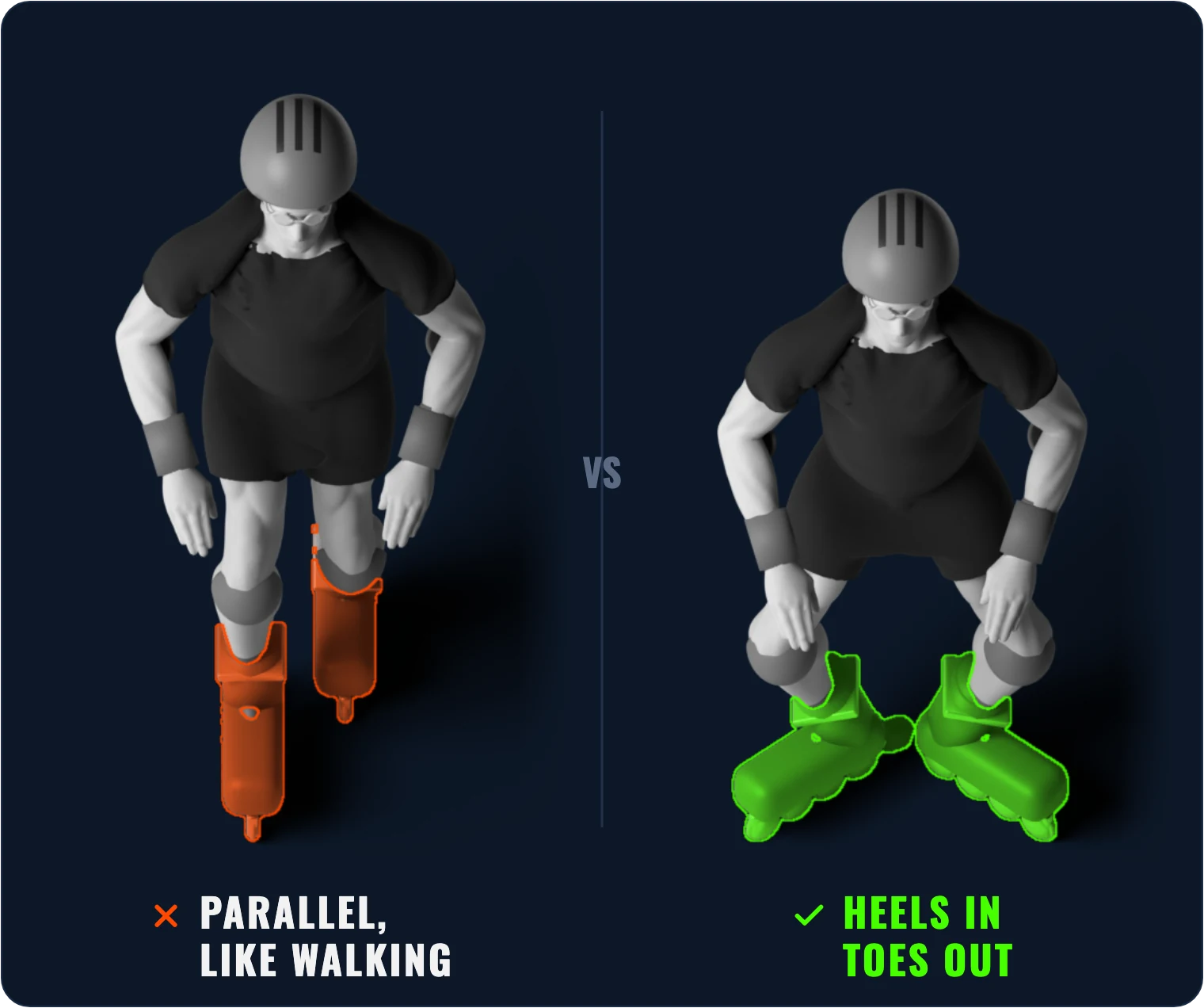
Get into the "ready stance": knees clearly bent, back straight, upper body leaning slightly forward. Bring your heels together until they almost touch, toes pointing outward at a 45- to 60-degree angle. Your skates now form a clear "V". In this position, you won't roll backward.
2. Consciously Shifting Weight
The secret isn't in your legs — it's in your core. Shift your full weight onto your left leg until you feel the skate pressing firmly into the ground. That frees up your right leg, which now lifts effortlessly.
3. The Duck Walk
Lift the right skate slightly and set it down again a small step forward, angled outward. Once it touches down, shift your full weight onto it. Then lift the left, set it down forward-left, shift weight back. Keep the steps small and choppy at first — it looks like a waddle, hence the name.
4. From Walking to First Gliding
Once you've found the rhythm, gradually increase pressure on the inside edge. Let your foot roll minimally forward-outward for a moment as you set it down. Rigid walking gradually turns into a first, brief glide — the precursor to a real skating stride.
Common Mistakes
- Walking in a straight line like street shoes: Parallel feet moving forward let the wheels slide out from under you. Keep the V-position consistently.
- Not enough knee bend: Locked legs shift your weight onto your heels — raising your risk of falling backward.
- Staring at your skates: Look down constantly and your back rounds, hurting your balance. Head up, eyes 3-5 meters ahead.
- Steps too big, too fast: Jump straight to big steps and you lose control over the weight shift. Start small — speed comes naturally later.
- Tensing your arms: Some beginners lock their arms rigidly against their body. Relaxed, naturally swinging arms help your balance far more than restricting them does.
Safety Notes
Full protective gear is mandatory while learning your first steps. Feel yourself tipping backward? Remember the most important rule: "Oh no, go low!" Bend your knees even deeper and bring your hands forward — that either restores your balance or guides you into a controlled fall onto your knee pads. Only practice on flat ground with no slope — you won't learn to brake until level 8.
Pro Tip
Many beginners get mentally stuck when it's time to fully lift the skates. This helps: the clown shoe visualization. Imagine your skates are huge, heavy clown shoes. It helps your brain consciously lift your feet off the ground and set them back down cleanly in the V-position, instead of nervously shuffling across the asphalt.
FAQ
How long until the V-Walk feels stable?
Usually two to three short 15-20 minute sessions are enough. Repetition matters more than total time — practice short and often rather than once, long, and exhausted.
Do I need grass to practice, or can I start straight on asphalt?
Grass is just a safety net for your very first, shakiest attempts. Once you feel steadier on your feet, switch to smooth asphalt — that's where the gliding motion actually starts to work.
Why can't I just walk normally on skates?
Because normal walking relies on a straight heel-to-toe roll — on wheels, your feet just slide out from under you. Skating needs sideways pressure through the edge, which is exactly what the V-Walk trains.
What do I do if I keep losing balance during the V-Walk?
Bend your knees deeper and take smaller steps. Most balance problems come from steps that are too big or legs that are too straight — both are easy fixes.
When am I ready for the next step, forward gliding?
Once you can do the V-Walk smoothly for several meters without losing balance or constantly looking down. At that point, your feel for weight shift carries over directly into real gliding.
Key Takeaways
- The V-Walk teaches you the sideways propulsion that's fundamentally different from normal walking.
- The V-position with your heels together keeps you from rolling backward.
- A bent-knee ready stance is essential to safely shift your weight from one leg to the other while stepping.