Forward Striding and Gliding
Does your skating stride feel like waddling? Learn the real V-push and the three phases — push, glide, recovery — for smooth, tireless gliding.
Introduction
Why does your forward stride on skates feel like waddling instead of real gliding? The honest answer: you're still walking, not skating. Normal walking runs straight from heel to toe — skating needs a completely different, sideways drive.
In this guide you leave the rigid V-Walk behind and learn the real V-push and smooth forward gliding. This is the heart of every movement on wheels. Only shifting your weight cleanly from one leg to the other lets you skate without tiring, instead of grinding forward the hard way.
What You Need
- Full protective gear: Gliding demands far more from your balance than the V-Walk did — helmet and pads are mandatory.
- Snugly laced skates with a heel brake for lateral support.
- A clear, smooth surface: an empty parking lot — flat, no slope, dry, no grit, ideally with grass alongside. You'll learn to brake later; until then, roll to a stop or roll onto the grass.
Step by Step
The fluid skating stride runs in three phases.
1. The Push Phase: Pushing Sideways
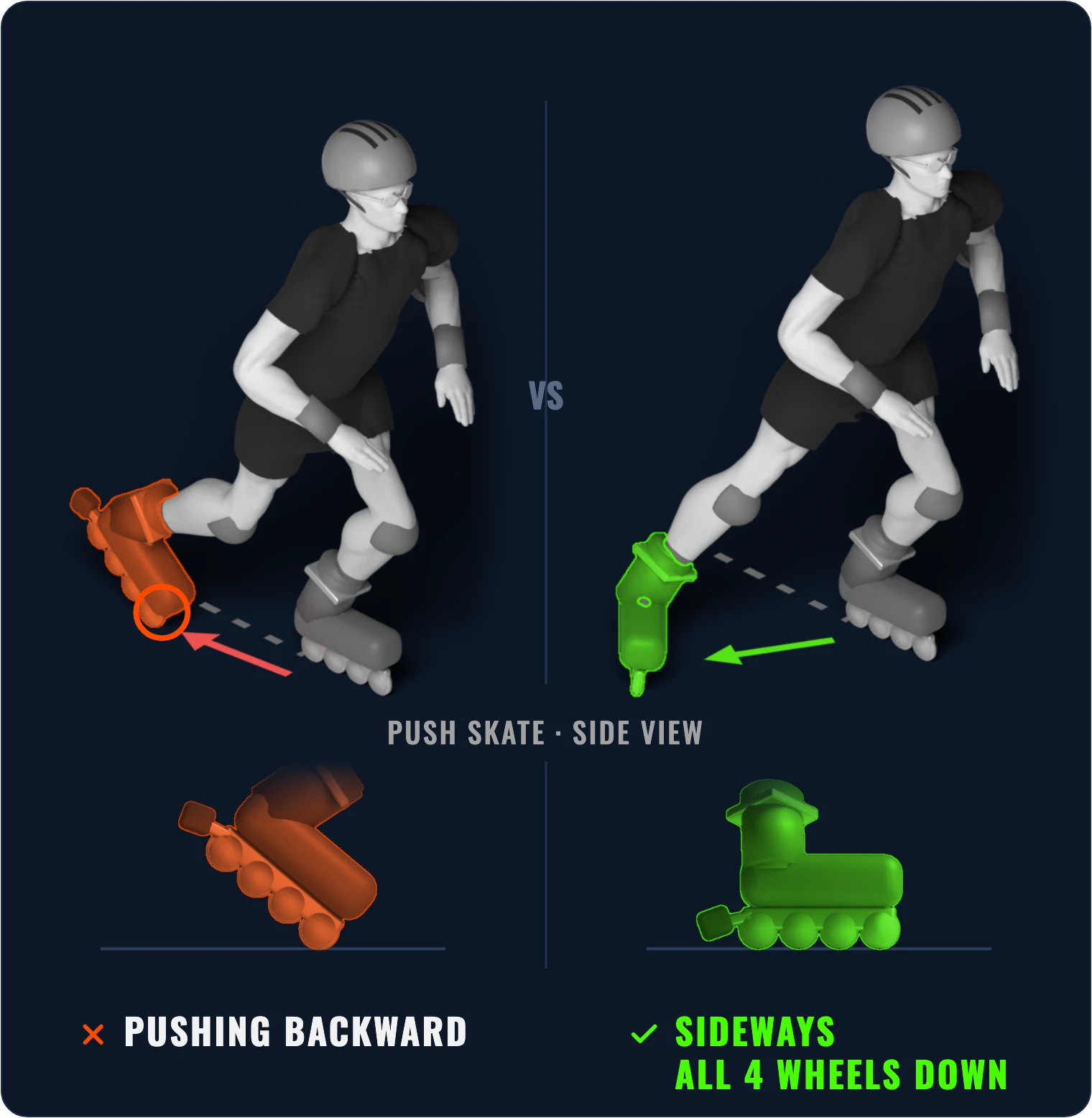
Start in the ready stance, feet in a slight "V". The push-off in skating never goes backward — always sideways. Extend your driving leg diagonally to the side in a controlled way and push into the ground with all four wheels at once, through the inside edge. Stay deep in your knees and ankles — this lengthens your extension and turns your thigh into the actual engine.
2. The Glide Phase: Rolling on One Leg
Once the push-off is done, shift your full weight onto the gliding skate under you and roll straight ahead on the center edges. This phase saves energy — your body relaxes briefly while you cover ground. The longer you glide stably on one leg, the more efficient and elegant your style becomes.
3. The Recovery Phase: Bringing It Back
While you glide up front, lift your fully extended pushing leg off the ground and guide it back in a soft arc under your center of mass. As the foot lands again, the toe points slightly outward once more (V-position) — your weight shifts there, and the other leg starts its next push.
Common Mistakes
- Stepping instead of gliding: Walking forward on the wheels like street shoes, instead of pushing sideways — this caps your momentum and often causes loss of control.
- Pushing off backward: Push backward and you slip off the front wheel (a "toe flick") — wastes energy and badly disturbs your balance.
- Stiff knees: Shifts your weight onto your heels, blocks a powerful push, and raises your risk of falling backward onto your back or head.
- Hectic short steps: Many beginners instinctively take lots of small, fast steps instead of fewer, longer pushes. That costs more energy and delivers less speed.
- Looking down: Watch your own feet while gliding instead of looking ahead, and you lose the core tension a clean glide phase needs.
Safety Notes
Balancing on one leg raises your fall risk. Feel yourself losing balance? The rule is always: "Oh no, go low!" Instead of throwing your arms up, immediately lower your center of gravity by bending deep into your knees — that centers your weight over the skates and often saves your balance. If a fall is unavoidable, you go down forward under control from that low position — knees first, hands off the ground.
To stop, as long as you can't brake yet: roll to a stop, or roll onto the grass and walk it out with small steps. In an emergency, get low and put one padded knee down (level 3).
Pro Tip
Once the three phases feel solid, focus on stroking: instead of hectic, short steps, deliberately let each push glide out longer. Longer, rhythmic glide phases lower your stride frequency while raising your speed — this saves enormous energy and is the secret behind how pros seem to glide effortlessly across the asphalt.
FAQ
Why does my forward stride still feel like walking instead of gliding?
You're probably still stepping forward instead of pushing sideways through the inside edge. Focus deliberately on push direction — sideways, not backward — and gliding follows almost automatically.
How long should the one-leg glide phase last?
As long as you stay stable on all four wheels without wobbling. One to two seconds is plenty at first — it extends naturally as your balance improves.
What am I doing wrong if I slip off the front wheel during push-off?
You're likely pushing backward instead of sideways (a toe flick). The push-off in skating always goes laterally through the inside edge, never straight back like in running.
Do I need to master the V-Walk perfectly before practicing this?
A confident feel is enough — you don't need perfection. The V-Walk gives you the weight-shift feel that you simply carry forward here with more momentum and a real glide phase.
What is stroking, and why is it more efficient than short steps?
Stroking means deliberately letting each push glide out longer instead of stepping hectically. It lowers your stride frequency and saves energy and oxygen — which is why experienced skaters look so effortlessly fast.
Key Takeaways
- Skating needs sideways drive through the inside edge — completely different from the straight-line roll of walking.
- The skating stride runs in three phases: push, glide, and recovery.
- Deep knees lengthen your push and keep you stable — straight legs cost you power and balance.