Skating Swizzles (Lemons)
Swizzles (lemons) teach you edge control without ever lifting your feet off the ground — the essential drill on your way to real gliding and slalom.
Introduction
"How do I get from standing stiffly to actually gliding, without immediately tipping over?" Honest answer: swizzles — also called lemons, bubbles, or sculling. This one drill is the key to that transition, and at DOMISPORTS we consider it the single most important foundational exercise in skating.
Swizzles teach you what's called edging: shifting from the center edge of your wheels to the inside edge, without ever lifting a foot off the ground. Along the way, you train your proprioception — your sense of where your body is in space. That exact weight distribution is what you'll need later for the forward stride, tight turns, and slalom.
Most beginners underestimate this drill because it looks so simple. But it's exactly where your speed foundation gets built: without clean edging, every stride stays weak, because you're not channeling the energy of your push onto the edge — you're just letting it dissipate.
What You'll Need
- Full protective gear: helmet, wrist guards, elbow pads, knee pads.
- A smooth, flat surface: an empty parking lot, a schoolyard outside school hours, or a skate area — bumps make gliding unnecessarily hard. Not a bike path: in Germany, inline skaters legally count as pedestrians and may only use bike paths where an extra sign allows it — and there's no room to practice between cyclists.
- Snugly laced skates (hard or soft boot — what matters is a snug fit) that give you lateral support so you don't collapse uncontrolled onto your inside edge.
- Cones (optional): handy later to check the shape of your lemons.
Step by Step
1. The Starting Position
Get into the ready stance: knees bent strongly, upper body straight and tilted slightly forward from the hips. Heels together, toes pointing out — the familiar V shape.
2. Open the Lemons
From the V, push your skates evenly outward on a diagonal, forward and out. Bend your knees as you go and use the inside edges of your wheels. Your legs now trace the top half of a lemon. Don't go much wider than shoulder-width.
3. Close the Lemons
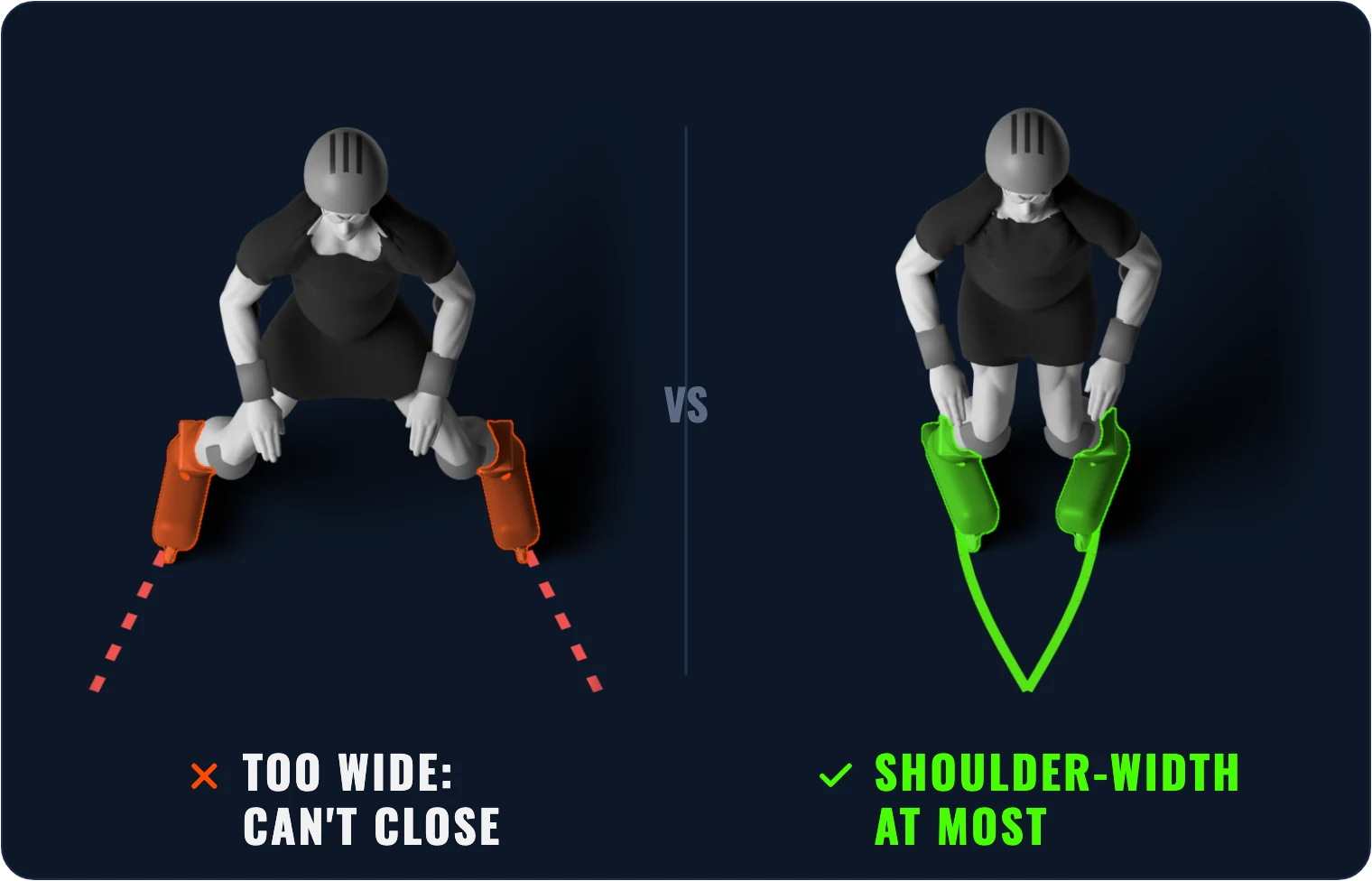
Once you're about shoulder-width apart, reverse the motion: turn your toes inward (almost pigeon-toed) and stay on your inside edges — the skates then curve back together on their own. Straighten up a little as you do. Don't actively squeeze your thighs together — the edge makes the curve. By the end, your toes almost touch.
4. Find the Rhythm
From the closed position, move straight back into the V and start the next swizzle. This traces a flowing, egg- or lemon-shaped line on the asphalt. Rule of thumb: don't rush it, precision beats speed.
5. Practice Both Sides
Keep repeating open-close until the movement feels equally natural on both sides.
Common Mistakes
Opening your legs too wide makes closing unnecessarily hard — you get stranded in the wide position. Stay at about shoulder-width at first. Stiff, locked knees kill all propulsion: the entire push of a swizzle comes from bending and extending your knees. Leaning forward while closing puts your weight on your toes — then the skates won't come back together. Keep your upper body upright over your hips.
Safety Notes
Keep your posture clean during swizzles too: with straight legs, your weight shifts onto your heels — that raises your risk of falling backward, onto your tailbone or the back of your head. Our rule of thumb applies here too: "Oh no, go low!" If your legs slide too far apart, turn your toes inward — the skates come back. If that's not enough, get low and let yourself fall forward onto your knee pads in a controlled way, instead of flailing your arms. That said, never lean too far forward over your feet while actually skating — that's a recipe for a forward fall.
Pro Tip
Once the forward movement feels solid on both sides, turn it into an intense leg workout: instead of stopping at the end of a swizzle, slowly perform the same motion backward (a backward lemon). This trains your edge control in both directions and sets you up for your first slalom moves. Count out loud while you practice ("open, close") — it forces an even rhythm.
FAQ
What exactly are swizzles, and why do I need them?
Swizzles (also called lemons) are the drill where you open and close your legs while standing, without lifting your feet off the ground. They teach you edge control and weight distribution — the foundation for everything that follows: forward skating, turns, slalom.
Why do I keep getting stuck in the wide position and can't pull back together?
You're probably opening too far — or trying to pull your legs together with force. Stay at about shoulder-width at first, then turn your toes inward and stay on your inside edges: that way the skates curve back together on their own.
Should I practice small, quick swizzles or big, slow ones?
Calm and even ones — and at first no wider than about shoulder-width. Rushed movements make a clean edge change hard; overly wide ones put you in the wide position that's hard to come back from. Size and speed come with time.
What's the "backward lemon," and when should I practice it?
It's the same open-close motion, just performed backward, right after a normal forward swizzle. Practice it only once your forward swizzles feel solid on both sides — it trains your edge control in multiple directions and preps you for slalom.
Which edges of my wheels should I be on while opening the lemons?
The inside edges. Opening pushes outward over the inside edges; when closing, you turn your toes inward and stay on the inside edges — the edge guides the skates back in a curve. Keep your upper body upright so your weight doesn't slide onto your toes.
Key Takeaways
- Swizzles train the shift from your wheels' center edge to the inside edge without ever lifting a foot off the ground.
- Skate your lemons calmly and evenly — at first no wider than about shoulder-width.
- Your upper body stays upright over your hips — lean forward and your weight lands on your toes, and the skates won't come back together.