The Scissor Stance
The scissor stance helps you over cracks and edges in the pavement: one foot forward, more weight back — so you roll over obstacles instead of tripping on them.
Introduction
"Why does every crack in the asphalt nearly knock me over?" Honest answer: because you're skating with parallel feet. When both wheels hit an obstacle at the same instant, it brakes you abruptly — and your upper body keeps going. The fix is the scissor position, and it's the most important technique you'll need the moment you leave perfectly paved ground behind.
Once you're skating around a city, small traps are everywhere: rough pavement, cracks, gravel, dropped curbs, tram tracks. The scissor position is built exactly for this — an evolution of your ready stance that lets you roll over obstacles instead of tripping on them.
What You'll Need
- Full protective gear: helmet, wrist guards, elbow pads, and knee pads are mandatory when practicing on uneven terrain.
- Snugly laced skates that give your ankle enough lateral support in the split stance.
- The right environment: practice standing on grass first, then move to smooth asphalt, then work your way up to small bumps (cobblestones, small cracks).
Step by Step
1. From the Basic Stance Into the Scissor
While rolling, drop into a deep ready stance — knees bent strongly, skates parallel at shoulder-width. Now push one foot (usually your dominant one) straight forward, in a narrow track. Your feet are now positioned one behind the other, like the blades of scissors. Rule of thumb for spacing: the back wheel of your front skate should line up roughly with the front wheel of your back skate.
2. More Weight on Your Back Leg
This is the key part: your weight is NOT split evenly. The bigger share rests on your back leg — you get there by bending your rear knee, not by leaning back. That makes your front skate "light" and lets it roll over small obstacles instead of getting stuck on them.
3. The "One Wheel at a Time" Principle
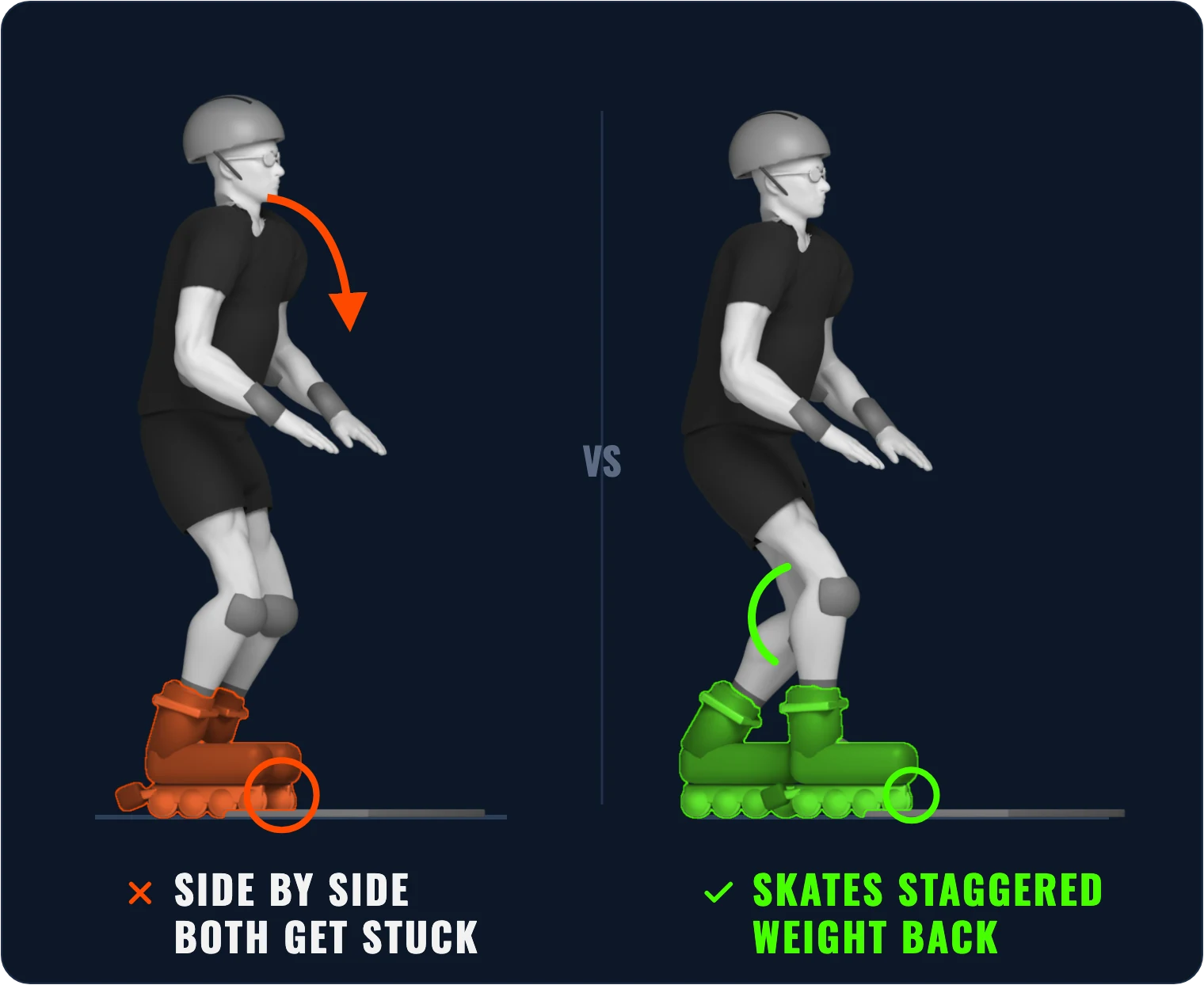
Because your skates are staggered, the wheels hit an obstacle one after another instead of both at once. The unloaded front skate glides gently over it, and the back skate follows a beat later. On top of that, the longer platform catches you in front — you fall forward less often.
4. Keep Your Knees Low (Your Shock Absorbers)
Stay low in your knees in this position. When the front wheel hits an obstacle, your bent knee absorbs the impact — like a car's shock absorber. A straight leg sends the jolt straight into your upper body.
5. Train Both Sides
Practice the scissor position with your left foot forward and your right foot forward — on the street, the road decides which side you need, not your preference. Side effect: the foot that rolls more steadily in front becomes your braking foot for the heel brake in level 8.
Common Mistakes
Not bending your knees enough is a typical mistake: if the skate brakes on an obstacle while your legs are stiff, the jolt goes straight into your upper body — and that wants to keep going forward. Standing too wide (an A-shape instead of a narrow track) costs you stability and the ability to balance your weight cleanly over your center. Weight on your front foot practically digs the front wheel into the obstacle — you get stuck and trip over your own foot.
Safety Notes
Uneven terrain is one of the main causes of falls for beginners, so always wear a helmet and pads. If you lose your balance in the scissor position on bumpy ground, don't try to straighten up. Instead, bend your rear knee even deeper to lower your center of gravity. Our rule of thumb applies here too: "Oh no, go low!" — it often stabilizes you right away, or at least makes the fall onto your knee pads more controlled.
Pro Tip
Most skaters have a favorite side and always push the same foot forward. That's not enough on the street — you need to be able to drop into the scissor with either your left or your right foot forward, instinctively and in a split second, depending on which side the obstacle shows up. Practice switching on the fly on smooth asphalt: right forward, parallel, left forward, parallel. Master both sides, and you'll glide through any city with confidence.
FAQ
What exactly is the scissor position, and when do I need it?
The scissor position is a staggered stance where one foot is in front of the other, with the bigger share of your weight on the back leg. You need it the moment you hit uneven ground — rough asphalt, cracks, curb edges — because it absorbs obstacles one wheel at a time instead of all at once.
Why do I fall when I roll over a crack with parallel feet?
Because both wheels hit the resistance at the same instant, braking you abruptly while your upper body keeps moving forward. That's exactly what the scissor position prevents: your feet are staggered, so the wheels hit one after another instead of together.
How do I get the weight split right in the scissor position?
Bend your rear knee until the bigger share of your weight sits there, while your front leg glides over the ground almost weightless — without leaning back. If your front foot feels "heavy," you haven't found the split yet.
Do I need to practice the scissor position on both sides, or is my strong side enough?
Both sides, no question. On the street, the position of the obstacle decides which foot needs to be forward — not your preference. Practice switching between right-forward and left-forward on smooth asphalt until both feel equally natural.
What do I do if I lose my balance in the scissor position while rolling over an obstacle?
Don't straighten up. Bend your rear knee even deeper to lower your center of gravity — that often brings you back into balance, or at least turns it into a more controlled fall onto your knee pads instead of a hard fall forward.
Key Takeaways
- The scissor position, with more weight on your back leg, is your most stable stance for uneven ground.
- Because your feet are staggered, your wheels hit obstacles one at a time instead of together — and the longer platform catches you in front, so you fall forward less often.
- Stiff legs are a typical mistake: the jolt goes straight into your upper body instead of your knees.