Foot Strike: Heel to Forefoot
Heel, midfoot, or forefoot: your foot strike decides between joint pain and running economy. Here's how to land right under your center of mass every time.
Introduction
Modern sports science no longer sees running as a purely instinctive movement, but as a highly complex biomechanical system. The hottest point of debate here: foot strike.
The reason this matters at all: with every step, shockwaves equal to roughly 3.5 to 4.0 times your body weight shoot through your shins, knees, and hips — at 75 kilos, that's over a quarter ton that needs to be cushioned with every single stride.
To absorb these forces, the right landing is decisive — and the honest answer is: there's no single perfect foot strike for everyone. Whether heel, midfoot, or forefoot: more important than which part of the foot touches down first is the position of your foot relative to your center of mass.
If you learn to land softly and in the right spot, you significantly boost your running economy and drastically lower your risk of shin splints or knee pain.
What You Need
- Running shoes: Well-fitting running shoes matched to your pronation type, with appropriate cushioning (after a professional gait analysis).
- A flat practice route: An asphalt path or firm forest trail with no obstacles, so you can focus fully on your feet.
- A smartphone camera (optional): To have yourself filmed from the side — this is the best way to see exactly where your foot actually lands.
Step by Step
1. Understanding and Accepting the Three Running Styles
Every running style has its pros and cons.
With heel striking, you roll from heel to toe. Common at slow paces and among beginners, it's easy on the calves, but if done incorrectly, it channels impact forces straight into the knee.
Forefoot striking absorbs impact excellently through the muscles and is very dynamic, but puts extreme strain on the Achilles tendon and calf.
Many consider midfoot striking the economical compromise for endurance distances: the foot lands flat, the load distributes evenly, and the impact is converted directly into propulsion. But as a beginner, don't force yourself unnaturally into a new style — focus on the following steps instead.
2. Finding the Optimal Landing Point Under Your Body
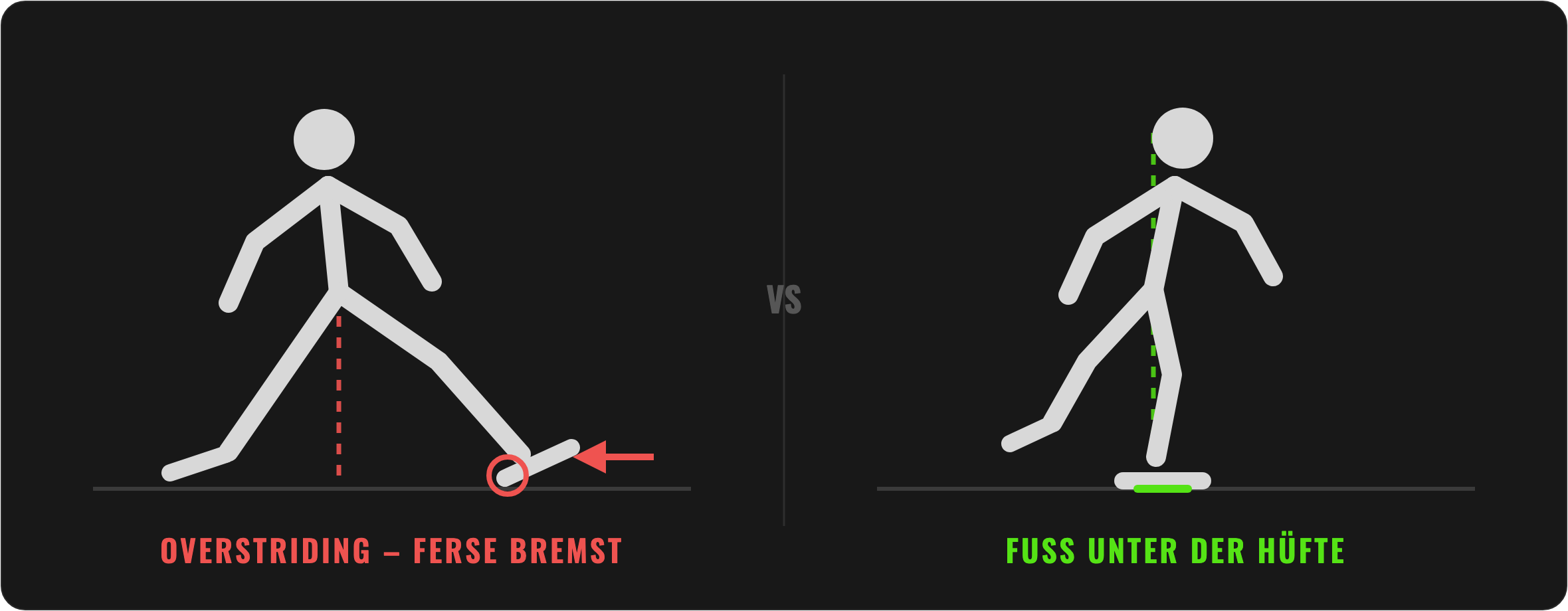
The biggest mistake in running isn't landing on the heel — it's landing the foot far in front of the body. Instead, land your foot as directly as possible under your center of mass.
When your foot first touches the ground, your shin should be nearly vertical and your knee slightly bent. If you land too far forward (overstriding), your leg acts like a brake block, destroying forward energy and jarring your joints.
3. Landing Quietly and Softly
An excellent indicator of good technique is sound. A quiet foot strike shows that you're actively cushioning the impact forces through your muscles — like a natural shock absorber — instead of letting your joints slam down passively.
Deliberately land your foot gently and smoothly. Imagine you're moving over a delicate surface and don't want to wake anyone up.
4. Increasing Stride Frequency (Cadence)
The most effective lever for foot strike is your stride frequency. Beginners often take far too long, sweeping strides. If you shorten your stride length and increase your frequency, your foot lands almost automatically in the correct spot under your center of mass.
The goal: many small, rhythmic steps that create a smooth, joint-friendly stride.
Common Mistakes
- Overstriding. Reaching far forward with an almost fully extended leg. This generates a massive braking impulse with every step and channels damaging forces unfiltered into your knee and hip. Fix: let the foot land under the hip, increase cadence.
- A radical, forced style change. If you've heel-struck for years and switch to forefoot striking overnight, you risk severe overuse of the calf and Achilles tendon. Fix: make adjustments gradually over months.
- Heavy "stomping." If you run into the ground with force instead of gliding lightly over it, you waste an enormous amount of energy and fatigue prematurely. Fix: run light-footed and quiet.
Safety Notes
As long as you run completely pain-free, there's no reason to forcibly change your natural foot strike (e.g. heel striking).
But if you repeatedly get problems with your knees or shins ("shin splints"), have your landing position (keyword: overstriding) checked by an expert or through a treadmill gait analysis.
Pro Tip
If you notice you're landing too far in front of your body, increase your stride frequency by about 5 percent — without actually running faster. Analyses show: a cadence of 170 to 180 steps per minute efficiently eliminates overstriding, shortens ground contact time, and pulls your foot strike in perfectly under your pelvis — short, quick steps instead of long bounds.
Use a metronome or music with the right BPM (beats per minute) to practice the rhythm!
FAQ
Is forefoot striking really better than heel striking?
No, there's no universally best foot strike. What matters isn't which part of your foot lands first, but whether it lands directly under your center of mass. If you run pain-free with a heel strike, there's no reason to force a switch to forefoot — that would just overload your calf and Achilles tendon.
Do I need to completely change my running style if my knee hurts?
Not immediately, and not radically. First check whether you're overstriding — landing with your foot far ahead of your body. Try simply increasing your cadence by about 5 percent. That usually corrects the landing automatically, without forcing you to overhaul your entire style overnight.
How do I find my ideal cadence?
Count how often your right foot hits the ground in one minute and double it. If you're well under 170 steps per minute, try a metronome or music at the right tempo. Increase the frequency gradually, not abruptly — your body needs weeks to adapt to the new rhythm.
Why does my knee still hurt even though I supposedly land "correctly"?
Foot strike is just one piece of the puzzle. Footwear, training volume, and muscular imbalances all play a role too. If the pain persists or changes your gait, don't self-diagnose — a treadmill gait analysis with an expert shows you what's actually going on.
Key Takeaways
- The foot should always be placed as directly under the center of gravity as possible to minimize braking forces.
- A quiet, soft foot strike protects the joints and indicates good muscular shock absorption.
- A slightly increased step frequency (cadence) is the easiest way to avoid overstriding and excessive impact.